

Microfrontends are reshaping how we build complex front-end applications. Just as microservices transformed back-end development by introducing modularity and team autonomy, microfrontends apply the same ideas to the user interface.
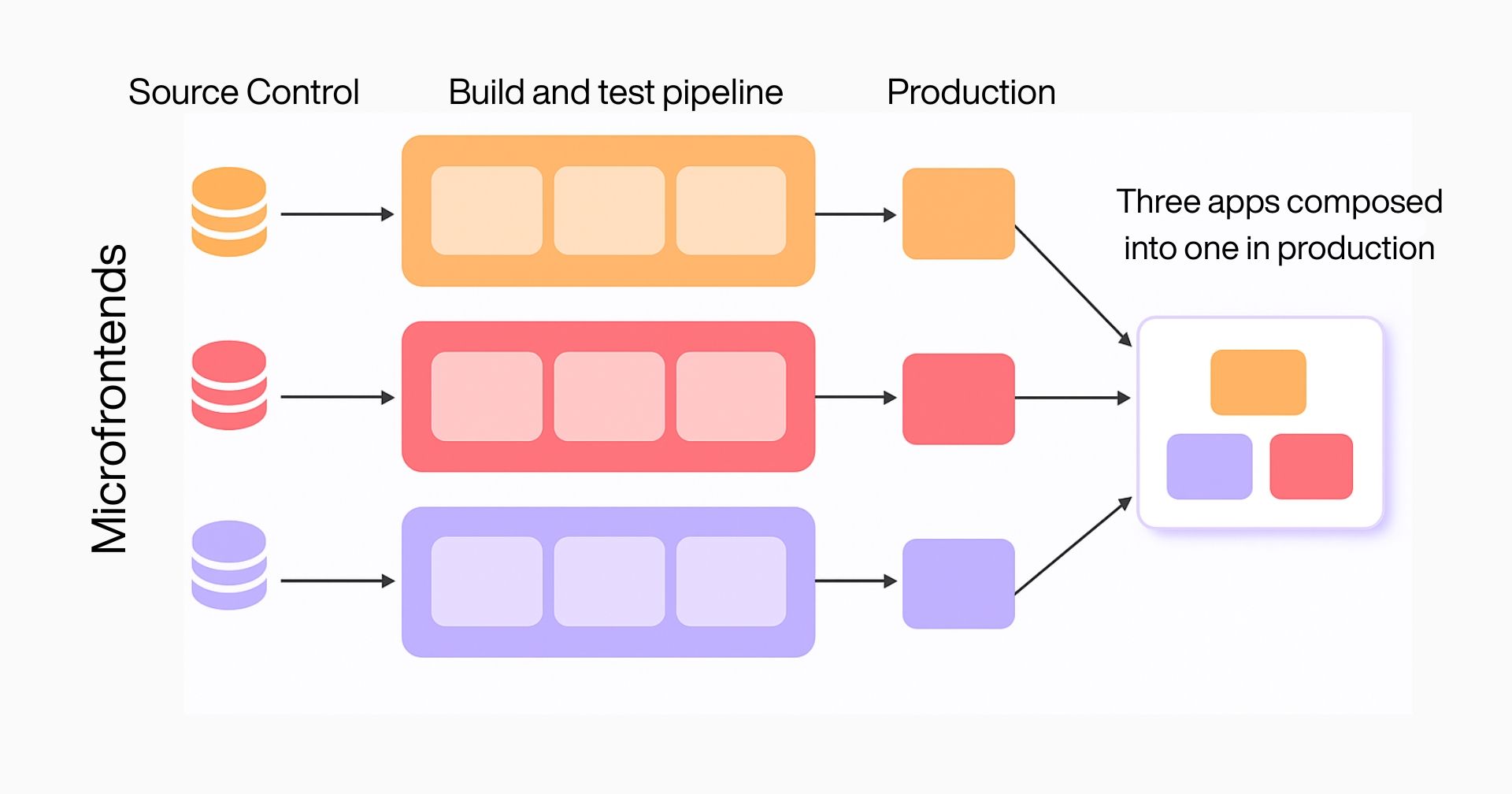
But if you’re expecting a clean, universal approach, you’ll be disappointed. There are multiple ways to architect microfrontends, each with its own set of trade-offs and choosing the right one depends on your product scale, team structure, and technical goals.
Think of microfrontends not just as a technical pattern, but as an organisational enabler. They let different teams develop, deploy, and evolve parts of an interface independently without waiting for the rest of the application to catch up. That freedom can dramatically speed up product delivery and reduce cross-team friction. But it also means you have to be deliberate about how the pieces come together.
Let’s look at three core integration strategies: route segmentation, iframe-based isolation, and JavaScript composition using an app shell. Along the way, we’ll touch on how AI is beginning to influence this space, from smarter deployment pipelines to runtime adaptation.
Route Segmentation
The most straightforward way to build microfrontends is to divide your app by route. In this model, each URL path like /home, /catalog, or /cart loads a different micro-app. Each microfrontend is a fully self-contained single-page application, often with its own framework, tooling, and release pipeline. From the user’s perspective, the transition between pages feels normal. But under the hood, they’re navigating between isolated apps.
This model works well when your features map neatly to distinct pages. It allows teams to modernise gradually, perhaps leaving one part of the app in Angular while migrating others to React.
The downside is performance: each route may load its own JavaScript bundle, sometimes duplicating dependencies like frameworks or shared libraries. Teams mitigate this with caching, shared CDNs, and lazy loading, but the cost is still real. Despite that, route segmentation remains one of the most popular ways to introduce microfrontends into existing architectures.
Iframes
Iframes are the oldest trick in the web developer’s book and surprisingly, they’re still relevant in microfrontend architecture. When you need hard boundaries between frontend modules, nothing beats the sandboxing that an iframe provides. Each microfrontend lives on its own URL, loads in its own browser context, and can’t affect the rest of the application unless explicitly wired to do so.
This strategy is most useful when integrating legacy systems or third-party content you don’t fully control. It also shines when security or fault isolation is a top concern: a buggy iframe won’t crash the whole app. But the trade-offs are steep.
Communication between frames is clunky, styling is difficult to unify, and performance often takes a hit. Each iframe might load its own version of a framework, design system, or analytics tool. As a result, while iframes still have niche uses, they’ve largely been supplanted by more elegant composition techniques.
JavaScript Composition
If route segmentation is the beginner’s microfrontend pattern and iframes are the safety-first fallback, JavaScript composition is where modern frontend architecture really shines.
This approach centres on an "app shell", a lightweight container responsible for rendering the page layout, navigation, and dynamic loading of microfrontend modules. Instead of loading entire apps per route, the shell stitches together microfrontends into a unified single-page experience.
The magic happens at runtime. Tools like single-spa orchestrate mounting and unmounting microfrontends based on route or state. Meanwhile, Webpack Module Federation lets apps share code directly across bundle boundaries, so you don’t ship React five times.
The result is a seamless user experience: shared navigation, consistent styling, dynamic code loading, and truly independent deployments. Of course, the complexity increases. Teams need to coordinate interface contracts, manage shared dependencies, and ensure styles and global state don’t leak between apps.
But when done right, JavaScript composition enables an architecture that scales with both your team and your codebase. It’s no coincidence that many enterprise-scale apps from e-commerce giants to fintech platforms now rely on some version of this approach.
The AI Angle
Artificial intelligence isn’t an integration strategy per se, but it’s starting to shape how we build and run microfrontends. On the developer side, AI tools are increasingly being used to scaffold boilerplate code, suggest module boundaries, and generate integration configs.
In large-scale systems with dozens of microfrontends, AI can also help manage complexity surfacing dependency conflicts, detecting duplication, and flagging performance regressions before they hit production.
Looking ahead, the most interesting potential lies in runtime adaptation. Imagine an AI that monitors user behaviour and dynamically assembles the UI choosing which microfrontends to load based on context, performance, or personalisation rules.
Or a system that uses machine learning to decide which version of a microfrontend to serve, as part of an automated experiment or gradual rollout. These are early-stage ideas, but they show how AI and microfrontends could complement each other in powerful ways.
Trade-offs and Choosing the Right Path
Each integration strategy has its moment. Route segmentation offers simplicity and a clear migration path from monoliths. Iframes offer maximum safety in hostile or legacy environments. JavaScript composition provides the smoothest user experience and the most flexibility, especially when combined with runtime code sharing. But it also requires the most coordination between teams, between modules, and between releases.
In the end, choosing how to implement microfrontends isn’t just a technical decision. It’s an organisational one. The right approach balances your current needs with your long-term vision. And just like with microservices, the best implementations don’t aim for perfection upfront; they evolve carefully, one boundary at a time.